Brittany Ferries sails Portsmouth to Santander directly across the Bay of Biscay, around two nights on board, up to twice a week, all year round. It’s the route for northern Spain and Portugal if you’d rather spend a couple of days on a ship than two days driving through France.
Research-based guideLast checked October 2026
We haven’t sailed this route ourselves yet, our own Brittany Ferries experience so far is on the shorter France crossings (see our Cherbourg and Saint-Malo write-ups). What’s below is based on route research and current operator information, we’ll update it properly once we’ve made the crossing.
Departures
Sailings run a few times a week rather than daily, and frequency drops in winter: in winter 2026/27 it is once a week out of Portsmouth, on Thursday night, and twice a week back. Because this is over a full day at sea rather than an overnight hop, treat it more like a short cruise than a quick crossing when you’re planning your schedule either side. Check current departure days and times at Brittany Ferries before booking.
Winter 2026/27 sailing times
| Direction | Day | Departs | Arrives |
|---|---|---|---|
| Portsmouth to Santander | Thursday | 23:30 | 08:00 Saturday |
| Santander to Portsmouth | Wednesday | 18:00 | 20:45 Thursday |
| Santander to Portsmouth | Saturday | 13:00 | 20:00 Sunday |
The regular pattern from 1 November 2026 to 21 March 2027, in local time. A few dates differ, so check yours when you book. Every route on one page: Portsmouth ferry times, winter 2026/27.
Ship and stay
This route is usually worked by the “Santoña”. She’s an LNG-powered ship built specifically for the Portsmouth to Spain routes, launched in spring 2023 and named after a fishing village between Santander and Bilbao. She has 341 passenger cabins plus 38 for truck drivers, all with en-suite bathroom, TV and a proper writing table, not just a bunk. Given the length of the crossing, a cabin isn’t really optional here the way it is on the shorter routes: expect a fuller range of onboard facilities too, multiple restaurants, lounges, entertainment and deck space, closer to a mini-cruise than a ferry in the Dover-Calais sense.

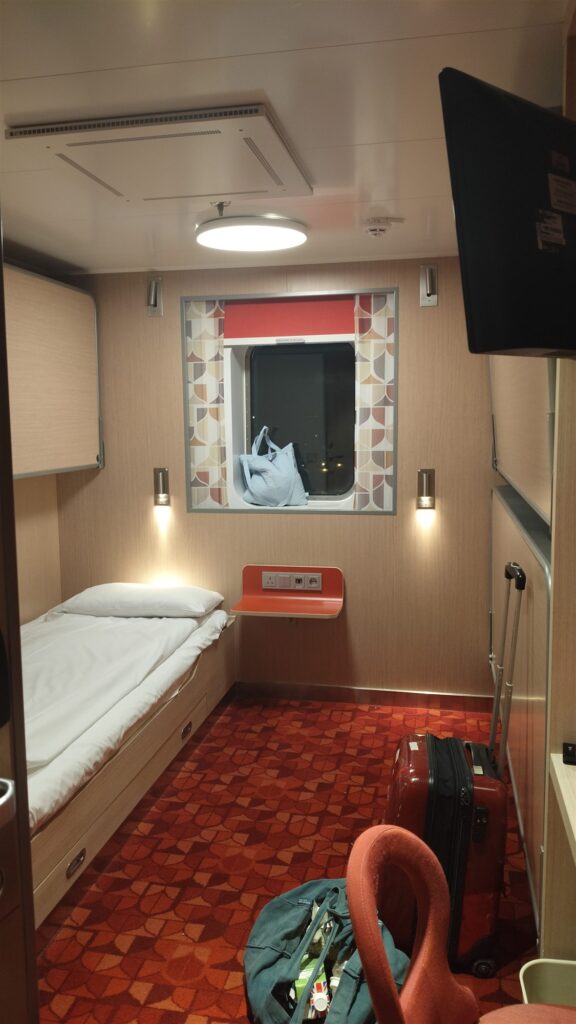
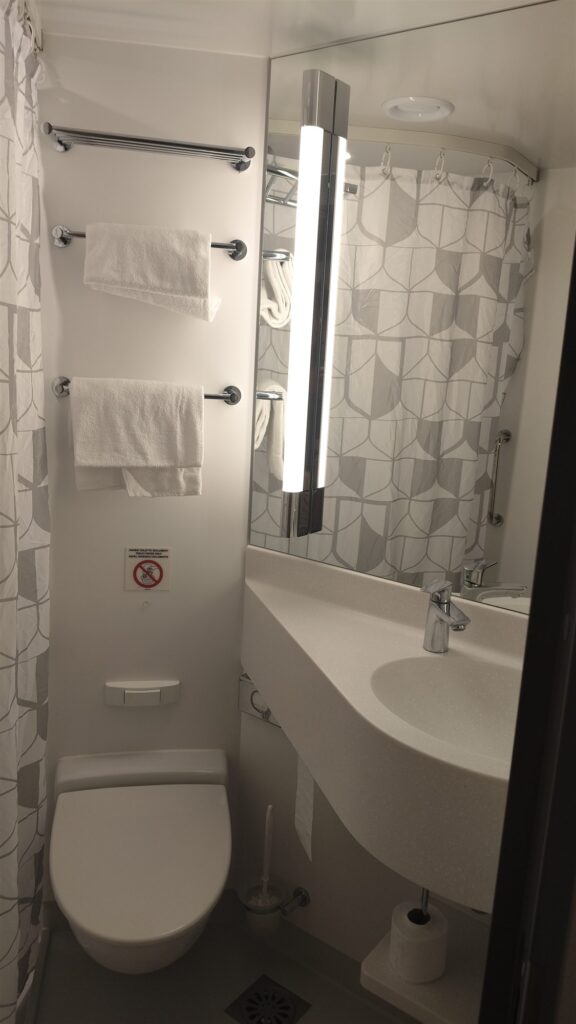
On cabin choice: for a crossing this long, an outside cabin with a window is worth the extra, both for the Biscay seasickness reasons below and for simply not spending two nights in a box. If your travel dates either side aren’t fully fixed, a Flexi ticket is worth the extra too, this is a low-frequency route and rebooking a fixed ticket at short notice is far harder than on the daily France crossings.
Departure from Portsmouth
Check-in for the longer routes tends to open earlier than on the short crossings, follow the time on your ticket. See our Portsmouth port guide for check-in, parking and getting to the terminal.
The Bay of Biscay has a reputation for rough water, and it earns it, particularly outside summer. A large ferry rarely cancels for weather, but you may well feel it. If you’re prone to seasickness, a cabin with a window and something to take before you feel unwell beats waiting until you do.
Arrival in Santander
Santander is a proper city arrival, not a transit-only port, with Cantabria’s coastline and the Picos de Europa within reach if you want to break the journey rather than push straight on. It’s also noticeably closer to central and southern Spain than Bilbao, if that’s where you’re ultimately headed.
Where you actually land. Santander is a city arrival in the proper sense: the terminal is right in the city, near the waterfront, so foot passengers can walk into the centre rather than needing onward transport first. The train and bus stations are close by for connections along the north coast.
For drivers it is a good starting point westwards. The Picos de Europa are around an hour and a half inland, Asturias continues west along the coast, and the motorway south towards Madrid takes roughly four and a half hours.
Costs and booking
This is the priciest type of crossing on offer from Portsmouth, you’re paying for a cabin and a much longer sailing, not just a Channel hop. Book ahead where you can, sailings are less frequent so there’s less room to be flexible at short notice than on the France routes. Check current prices at Brittany Ferries for your dates.
Alternatives
Portsmouth to Bilbao is the other direct Spain option, longer but lands you further into the Basque Country. If the Bay of Biscay crossing itself doesn’t appeal, driving down through France to a shorter Spain crossing further south is the usual alternative, though that trades ferry time for driving time rather than removing it. See all five routes on the Portsmouth ferries overview.
Worth the detour: San Sebastián
There’s no direct ferry to San Sebastián, it’s not a ferry port, but it’s only around an hour’s drive east of Santander along the coast. If you’re searching for a ferry there directly, Santander is your nearest option and a genuinely easy detour once you’ve landed.
FAQs
How long is the ferry from Portsmouth to Santander?
Around two nights on board (roughly 30+ hours), it varies by sailing and is closer to a mini-cruise than a quick crossing. The Spain comparison weighs it against Bilbao.
Santander or Bilbao, which is better?
Santander is the shorter crossing by about six hours and the better start for Asturias, Galicia and the drive into Portugal. Bilbao suits the Basque Country, Rioja and the drive south. Side by side on our ferries to Spain page.
Is the Bay of Biscay crossing rough?
It can be, especially outside summer. Large ferries rarely cancel for weather, but you may feel the motion. A cabin with a window helps if you’re prone to seasickness, and our ships page covers what the Spain ships are like inside.
Do I need a cabin?
Not strictly required, but given the length of the crossing, most travellers book one rather than a reclining seat. What that adds to the fare is on the prices page.
Some links on this page are affiliate links: if you book, we may earn a commission, at no extra cost to you. How that works.