Brittany Ferries runs two direct routes from Portsmouth to northern Spain: Santander and Bilbao. Both cross the Bay of Biscay in full, so you skip the drive through France entirely. The real question is which of the two, and the answer is almost always about where you are going afterwards.


Researched, not sailed yet. We have not made either of these crossings. We sail Portsmouth to Bilbao in 2027 and will update this page afterwards. Our own Portsmouth experience is on the France routes, Cherbourg and Saint-Malo. Everything here comes from operator information and route research, and we would rather say that than write as though we had done it.
Santander or Bilbao, side by side
| Santander | Bilbao | |
|---|---|---|
| Crossing | approx. 30+ hrs | approx. 36 hrs |
| Nights aboard | 2 | 2 |
| Region | Cantabria | Basque Country |
| Winter 2026/27 | One a week, Thursday night | One a week, Tuesday night |
| Have we sailed it? | No | No, booked for 2027 |
Which port suits where you are going
The ports are close enough that the best one depends on your destination. Pick where you are heading and the map shows the drive from Santander and from Bilbao. Where the two are within a few minutes of each other, the sailing day is the better thing to decide on.
From Bilbao, Bilbao is the shortest drive at 16 min. Santander adds 1h02. Bilbao has one sailing a week out of Portsmouth this winter.
From San Sebastian, Bilbao is the shortest drive at 1h24. Santander adds 1h01. Bilbao has one sailing a week out of Portsmouth this winter.
From Oviedo and Asturias, Santander is the shortest drive at 2h14. Bilbao adds 50 min. Santander has one sailing a week out of Portsmouth this winter.
From Picos de Europa (Potes), Santander is the shortest drive at 1h24. Bilbao adds 50 min. Santander has one sailing a week out of Portsmouth this winter.
From Santiago de Compostela, Santander is the shortest drive at 5h30. Bilbao adds 50 min. Santander has one sailing a week out of Portsmouth this winter.
From Pamplona, Bilbao is the shortest drive at 1h57. Santander adds 1h02. Bilbao has one sailing a week out of Portsmouth this winter.
From Burgos, Bilbao and Santander are within about 25 minutes of each other on the road: Bilbao (1h57) and Santander (2h20). That is too close for the drive to decide it, so let the crossing do that. How each one sails is below.
From Madrid, Bilbao is the shortest drive at 4h35. Santander adds 30 min. Bilbao has one sailing a week out of Portsmouth this winter.
From Barcelona, Bilbao is the shortest drive at 6h42. Santander adds 1h01. Bilbao has one sailing a week out of Portsmouth this winter.
From Valencia, Bilbao is the shortest drive at 6h48. Santander adds 1h01. Bilbao has one sailing a week out of Portsmouth this winter.
From Seville, Santander is the shortest drive at 8h55. Bilbao adds 28 min. Santander has one sailing a week out of Portsmouth this winter.
From Malaga and the Costa del Sol, Bilbao is the shortest drive at 10h25. Santander adds 28 min. Bilbao has one sailing a week out of Portsmouth this winter.
From Porto, Santander is the shortest drive at 7h04. Bilbao adds 34 min. Santander has one sailing a week out of Portsmouth this winter.
From Lisbon, Santander is the shortest drive at 8h56. Bilbao adds 28 min. Santander has one sailing a week out of Portsmouth this winter.
From Bordeaux, Bilbao is the shortest drive at 3h51. Santander adds 1h01. Bilbao has one sailing a week out of Portsmouth this winter.
From Toulouse, Bilbao is the shortest drive at 4h57. Santander adds 1h02. Bilbao has one sailing a week out of Portsmouth this winter.
Drive times and distances: route calculation on OpenStreetMap data (OSRM), 26 October 2026, from the ferry terminal to the centre of the place, without traffic, roadworks or stops. The calculator assumes cautious motorway speeds, so real drives can come in quicker: trust the gap between ports more than the total. The dashed lines from Portsmouth show the shape of each crossing, not the ships’ exact tracks.
Which one, in practice
The two ports are only about 100 km apart, so the difference is smaller than the crossing times suggest. For most trips it comes down to three things.
Heading west, or to Portugal: Santander. It is further along the coast in the right direction, it is the shorter crossing by around six hours, and it is the better start for Asturias, Galicia and the drive down to Porto.
Staying in the Basque Country: Bilbao. San Sebastián is about an hour away, Rioja is an easy drive south, and you are in the middle of what is arguably the best eating in Spain before you have properly unpacked.
Heading to Madrid or central Spain: whichever you can book. The drive south is much the same from either port. At that point pick on sailing dates and price rather than geography.
Two nights at sea is the actual decision
Both routes are closer to a short cruise than a crossing. That is the thing to weigh before you compare the two ports at all.
The trade is straightforward. Against driving through France you save roughly two days behind the wheel, the fuel, the tolls and a night or two in hotels along the way, and you arrive with the car loaded and everyone rested. Against flying you are obviously slower, but you have your own vehicle, no luggage limit, and no airport at either end.
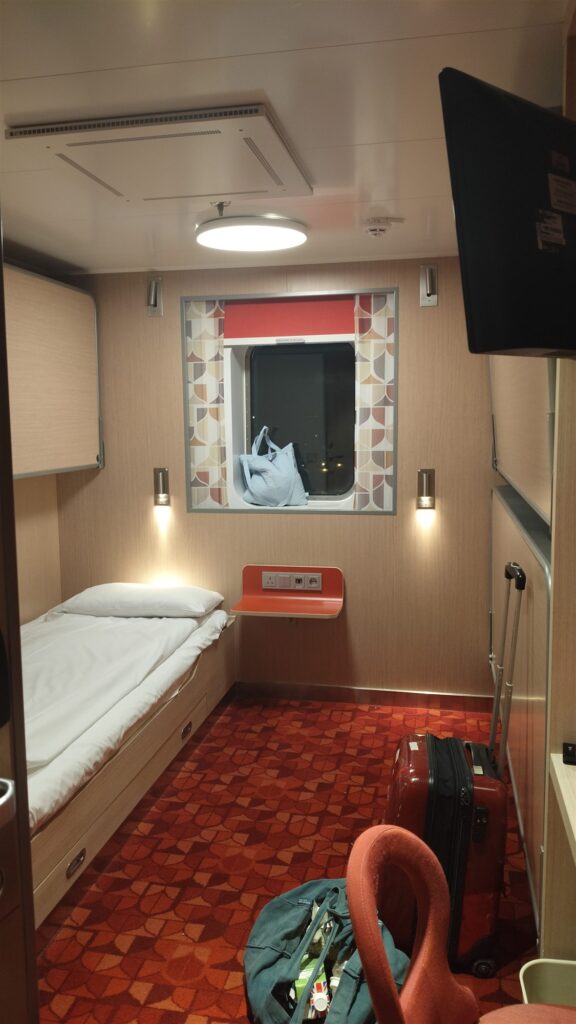
A cabin is not really optional on these. Two nights in a reclining seat is a long time, and unlike the Channel crossings there is no version of this trip where you just stay up.

The Bay of Biscay
Biscay has a reputation for rough water, particularly outside the summer months, and it is worth taking seriously if anyone in the party is a poor sailor. It is also why these crossings are popular with whale and dolphin watchers, since the ships cross deep water and there are organised wildlife watches on some sailings.
If rough seas are a real concern, the France routes plus a long drive remain the calmer option, however much less appealing that sounds.
Booking and frequency
Neither route is daily. In winter 2026/27 each runs once a week out of Portsmouth, Santander on Thursday nights and Bilbao on Tuesday nights, and that is the single biggest planning difference from the France crossings. A full sailing means waiting days rather than hours, so book these further ahead than you would for Caen or Cherbourg.
One illustration of how thin the schedule is: on the one Portsmouth departures board we photographed, a Tuesday in August, there was no Spanish sailing at all. Nine departures that day and not one of them to Spain. See our timetable guide.
The ships
The Spain routes get the larger ships in the fleet, which makes sense given how long people are aboard. Galicia is tied most closely to Bilbao, and we have photographed her leaving Portsmouth at sunset without ever having sailed on her. Santoña also works the Spain routes, and she is one we have been on, though on a Cherbourg crossing rather than to Spain. See ships from Portsmouth.

Both sail from the same terminal as everything else, covered in the Portsmouth port guide. To compare Spain against the France routes and the Channel Islands, see the Portsmouth ferries overview.
Routes and frequencies checked October 2026. Driving times are calculated estimates without traffic. We have not sailed either route yet and say so on every page where it matters.